Category Archives: Daily Dose Of Emuna

Loading
loading..

Being Humble and Happy

May 7, 2014
Orit Esther Riter
,
No Comments

BS’D

“Oseh Shalom b’mromav, Hu Ya’aseh Shalom Aleinu v’ol kol Yisrael (He makes peace in His Heavenly Heights)” (Iyov 25:2)

Rabbi Shimon ben Chalafta ztk”l teaches how beloved peace is to HaKadosh Baruch Hu when Hashem wished to bless Klal Yisrael.  He did not find any vessel in which to place the abundant blessing other than the vessel of peace as it is written; “Hashem oz l’ahmo yiten, Hashem yivarech et ahmo b’Shalom (Hashem gives strength to His people, Hashem blesses His people with peace)”.

Dispute creates distance and postpones tikkun olam (rectification of the world).  Whoever encourages peace creates unity throughout all of the worlds since one of Hashem’s names is Shalom (peace). The foundation of the entire world is peace which is embedded in Shabbat Hakedusha.  Shabbat merges the upper and the lower worlds.  If someone belittles peace, he loses his portion in the world to come.

This tefillah encourages peace amongst Klal Yisrael.  It is for this reason that we bow to the left, right and finally straight ahead, bending in all directions, while asking Hashem to make peace.  We must be flexible and mesh with all personalities.  We must seek tolerance amongst all walks of life.

Hashem asks that we make peace within our homes just as there is peace in Shamayim.  Home is the place to work on our middot because it is the place where all of our guards come down and we feel free to let off our steamy emotions.  Yet, the Torah teaches us that we should channel our emotions in order to attain a sense of inner peace.  It is vital to do a self-accounting on a regular basis and settle out one’s feelings in honesty.

“And the humble shall inherit the land…” (Tehillim 37:11)

Above all others the humble shall enjoy life.  Even if they must endure trials and tribulations, they enjoy a life of tranquility.

According to Rav Samson Raphael Hirsch ztk”l; the humble submit to Hashem’s will because they internalize the fact that their understanding and strength is limited.  They ‘wish to be only that which Hashem wants them to be, and nothing else.

Today’s daily dose is dedicated to the refuah shleimah of Devora Leah Bas Kayla Sara a 25 year old mother who just gave birth to her second healthy baby girl but she herself developed a blood clot and internal bleeding in her brain after giving birth.

Oy, Hashem, we need Your compassion to be revealed, all is good, but we wish to see it openly shown to us.  Please shower Devora Leah Bas Kayla Sara with rachamei Shamayim amongst all of Klal Yisrael who are sick and suffering in Klal Yisrael, b’karov, b’rachamim, amen.


Which One? Carrots, eggs or coffee

May 5, 2014
Orit Esther Riter

No Comments

 BS’D

A young woman went to her grandmother and told her about her life and how things were so hard for her. She did not know how she was going to make it and wanted to give up. She was tired of fighting and struggling. It seemed as one problem was solved, a new one would pop up. Her grandmother took her to the kitchen.She filled three pots with water and placed each on a high fire until they came to a boil. In the first pot she placed carrots, in the second she placed eggs, and in the last she placed ground coffee beans. She let them sit and boil; without saying a word. In about twenty minutes she turned off the burners. She fished the carrots out and placed them in a bowl. She pulled the eggs out and placed them in a bowl. Then she ladled the coffee out and placed it in a bowl.

Turning to her granddaughter, she asked, “Tell me what you see.”

“Carrots, eggs, and coffee,” she replied. Her grandmother brought her closer and asked her to feel the carrots. She did and noted that they were soft. The grandmother then asked the granddaughter to take an egg and break it. After pulling off the shell, she observed the hard-boiled egg. Finally, the grandmother asked the granddaughter to sip the coffee. The granddaughter smiled as she tasted its rich aroma then asked,

“What does it mean, grandmother?” Her grandmother explained that each of these objects had faced the same adversity: boiling water. Each reacted differently. The carrot went in strong, hard, and unrelenting. However, after being subjected to the boiling water, it softened and became weak. The egg had been fragile. Its thin outer shell had protected its liquid interior, but after sitting through the boiling water, its inside became hardened. The ground coffee beans were unique, however. After they were in the boiling water, they had changed the water.

“Which are you?” she asked her granddaughter. And we should ask ourselves, which one am I?

G-d’s Cake

May 1, 2014
Orit Esther Riter
No Comments

BS’D

ROSH CHODESH TOV TO EVERYONE!

(source unknown)

Sometimes we wonder, ‘What did I do to deserve this?’ or ‘Why did G-d have to do this to me?’ Here is a wonderful explanation!

A daughter is telling her mother how everything is going wrong, she’s failing in school and her best friend is moving away. Meanwhile, her mother is baking a cake and asks her daughter if she would like some and the daughter says, ‘Absolutely Mom, I love your cake.’

‘Here, have some cooking oil,’ her mother offers.

‘Yuck’ says her daughter.

‘How about a couple raw eggs?’

‘Gross, Mom!’

Would you like some flour then? Or maybe baking soda?’

‘Mom, those are all yucky!’

To which the mother replies , ‘Yes, all those things seem bad all by themselves, but when they are put together in the right way, they make a wonderfully delicious cake!’

G-d works the same way. Many times we wonder why He would let us go through such seemingly bad and difficult times. But G-d knows that when He puts these things all in His order, they always work for the good! We just have to trust Him and eventually they will all make something wonderful!
G-d is madly in love with you. He sends you flowers every spring and a sunrise every morning. Whenever you want to talk, He’ll listen.

Today’s daily dose of emuna is dedicated to the hatzlocha raba of Nissan ben Malka who was released from prison yesterday.  HODU L’HASHEM KI TOV, KI L’OLAM CHASDO!  May his life from this point forward be decorated with Torah, mitzvot and ma’asim tovim. amen. 

Hashem Loves You!

April 30, 2014
Orit Esther Riter

No Comments

BS’D

Most people don’t believe that Hashem loves or even likes them.  How is it that we don’t see the beauty, love and care gifted to us by Hashem?  Unfortunately human nature is such that recognition of Hashem’s compassion and attentive care comes when difficulty arises.  Suddenly that place of goodness shifts to a place of pain.  The fact that we distinguish between the two states demonstrates that hardships are out of the ‘ordinary’ agenda of life.

We must strive to cherish ourselves as much as Hashem treasures us.  For some reason we do not feel worthy of Hashem’s love and blessings.  When we daven we do not actually expect Hashem to fulfill our wishes.  Our tefillot are intermingled with doubts of whether we merit the yeshua (salvation).

Therefore the next time we daven it should be with a firm stance that the Borei Olam loves and listens to every tefilla even if it seems otherwise.  Hashem fulfills our wishes as He determines best in line with His infinite wisdom and His plan for creation. However, He directs and guides every facet, down to the microscopic detail with tender compassion and infinite love.  He sees the bigger picture; past, present and future and knows what yields the most favorite results for us.

If we do not love ourselves, how can we feel love of our Creator or anyone else for that matter?  If we do not cherish and value our lives we as though insult Hashem by proclaiming that He as if made a mistake when He created us.  Think about it and let the change begin within.

Today’s Daily Dose of Emuna is dedicated to the refuah shleimah of  Harav Meshulom Dov ben Chana Sarah.  Please click on the link below to read a passuk in tehillim in the merit of his refuah.  May he be zoche to a complete healing amongst all of Ahm Yisrael who are sick and suffering b’karov, b’rachamim, Amen.

http://tehilimyahad.com/mr.jsp?r=6IG1Eh5k9M

Staying focused

April 29, 2014
Orit Esther Riter

No Comments

BS’D

Staying focused is particularly challenging when praying for someone else’s yeshua (salvation)whom you may not even know.  For instance in the case where you receive the name of someone ill and are asked to daven for their refuah.  How can you daven with intention and a stir of the heart when you don’t even know the person involved?

The power of guided imagery is an indispensable tool to awaken feelings of empathy.  It is not enough to just think about the person but should take it one step further.  Visualize the patient, the physical and emotional pain they are steeped in.  Reflect upon the family members and the difficulty they are going through while seeing their loved one in pain.  It is important to see ourselves in that place and B’H warm sensitive feelings will follow enabling us to daven for them with more kavannah (intent).

The mind tends to drift into distant places during formal and informal tefilla.  Connecting with Hashem gets interrupted not just when our concentration takes us elsewhere but also when we cannot relate to Whom we are praying to. The Omer is intended to center us spiritually; moment by moment, day by day.   Tightening the bond between us and Hashem, visualizing how much He loves, provides for us and unconditionally looks out for our eternal best is the avodah of these 49 days.

Today’s Daily Dose of Emuna is dedicated to the refuah shleimah of Naomi bat Sarah.  She was badly burnt while koshering her kitchen for Pesach.  May Hashem shower her with rachamei Shamayim and may she merit a complete healing amongst all of Klal Yisrael who is sick and suffering b’karov, b’rachamim, Amen.

Foreign thoughts during tefillah

April 28, 2014
Orit Esther Riter

No Comments

BS’D

Today’s Daily Dose of Emuna is dedicated L’iluy neshmat Ronni Yosef ben Sima and Moshe a’h.  May his neshama bask in the Divine Radiance amongst all the tzaddikim who have departed from this world, amen.

A Chassidic vort describes a chassid who came to the Rebbe with the following complaint: “Rebbe, I have foreign thoughts.” “Foreign?” asked the Rebbe. “They aren’t foreign at all. They’re all yours.”

Chassidut teaches that when a particular issue is disturbing you try to “elevate” those foreign thoughts; to “elevate the sparks.” Translate the problem which occupies your thoughts into the language of prayer. Whether you are thinking about business or family or anything else, Hashem is certainly able to help you in solving the problem. Don’t banish the “foreign thought” from your mind; on the contrary – keep it with you, and turn that very thought into a prayer.

To get practical if you are thinking about how to pay your bills, turn it into a tefillah and ask Hashem to help you pay your bills.  Cast the thought to Hashem and appeal to Him, “I don’t want to worry about money.  I know that it is You that provides for me now and always.  Help me cast it to You and focus on my avodah and that which I do have control over.”

Pesach’s ultimate purpose, insights and segulot

April 8, 2014
Kayla Krauss
,
No Comments

BS’D

To view the latest emuna shiur on the DAILY DOSE OF EMUNA YouTube Channel:  Freeing ourselves from emotional slavery PLUS seder insights:  

Click here


 “Lets really get rid of the chametz,  no more loshon hora, lets all work on our Peh Sach, think before you speak!”    
 

Pesach_tfilah_heb
pesach_tfilah_eng2

imagesCA0VERC1

Pesach is filled with many messages of light and hope, the main one being emuna shleimah (complete and pure faith). The goal of this chag is to see ourselves as part of the Exodus and to thus feel Hashems loving care.  Ideally, this will fortify us and create a meaningful, lasting relationship with Hashem.

Rav Avigdor Miller ztk’l teaches that the story of Mitzrayim is truly a model of the life of every Jewish soul. For instance, contemplating the course of Yosef HaTzaddik’s life, including the trials and tribulations that led him to become the viceroy of Egypt, allows us to witness the hand of Hashem guiding his affairs. There are so many ‘If Yosef had not’s’ and ‘He would have never’s’ that led him to be second in command over the largest country in the world at the time. If these events had not occurred, Yosef could not have made it to the top.  Though it seemed he befell serious misfortunes, all events of Yosef’s life were benevolent and purposeful.

Just as we can study the life span and circumstances of Yosef’s life, in the future we will apply this perspective to our own lives.  Chazal teach that in the World to Come, mankind will study and understand the meaning behind all events of our lives. Every minute event in our lives represents links that make up our Jewish path and together form our history. As Dovid HaMelech ztk’l writes in Tehillim (145:17) ‘Hashem is just is all of His ways and kind in all of His deeds’.  We need to trust that all will be clear in due time.

We begin to eat matzah at the Pesach seder. Considered the poor man’s bread, matzah humbles us and reminds us of our former condition as slaves and how Hashem overturned nature in order to redeem His beloved children. This should fill our hearts with an outpouring of gratitude and happiness at the recollection of His abundant care.

Though there were numerous ways Hashem could have brought about our redemption He ‘chose’ to arrange the events in such a manner that His hand would be undoubtedly apparent.  In his mercy, He sought to assure the Jewish people that Hashem was with them and they were not alone.

In our Tefillah we mention Yetziat Mitzrayim numerous times a day to recognize and be grateful for Hashem’s kindnesses to each and every one of us. ”V’heegaditah l’vinchah bayom hahu la’mor ba’avur zeh asah Hashem li b’tzaitee(And you shall relate to your son on that day, saying: because of this that Hashem did for me when I went out of Egypt).”

The Gemara writes (Sanhedrin 37A), ‘Kol HaOlam lo nivrah ella bishvilee (All the world was created for my sake alone).  This belief should be echoed in our hearts every day, particularly when contemplating the exodus of Egypt, since each of us was there in spirit and was thus personally redeemed.  Each of us is a guest in Hashem’s world.  A good guest does not say, “Hashem doesn’t take the sun out just for me, the entire world enjoys its radiance, therefore what must I be thankful for!” Rather, a good guest feels that His host has troubled Himself specifically for him, even if others benefit from His hospitality.

Bedikat Chametz

We perform the ritual of bedikat chametz to the light of a single flickering candle.  The candle represents our spiritual essence, that which goes beyond rationale and logic. Often in this world, our inflated egos trap us and disable us from opening up, loving ourselves and others and growing.   While searching for the chometz, we can think of our true core and the chametz ‘hiding’ in us.  We can visualize isolating this ego part and imagine burning it the following morning along with the last pieces of chometz before Pesach. In contrast, eating, matzah frees us from this egocentricity and confinement.  Matzah gives us the strength to fight and be free.


imagesCAX78PXK

The Seder

Rabbi Simon Jacobson shlit’a of “The Meaningful Life Center” in NY teaches that the entire objective of the seder is to achieve transcendence.   The seder grants us the opportunity to break free from our fears, inhibitions and addictions.  

The purpose of the Seder night is to reawaken the feelings of slavery and then to transition us to freedom. Human beings often experience emotions most strongly via contrast.  By imagining ourselves in bondage and then being saved by Hashem, we are more able to feel in our hearts and thus acknowledge that we only have Hashem to rely upon. The true definition of freedom is recognizing that we are servants of an Omnipotent Being, that there is no one and nothing other than Hashem.  This is the definition of living with emuna shleimah.  This cements the understanding that we can therefore never be slaves to anyone or anything else.

Seeing ourselves in the story of the Hagaddah is immersing ourselves in history and in the past and future redemption. Every day of our lives we are required to come out of Mitzrayim, that is out of the constriction of our bodies and instead realize that we are G-dly.  This mindset expresses freedom, unlimited potential, endless abilities and immeasurable capacity to grow.  Hashem is infinite and limitless and therefore, when we attach ourselves to Him we are also limitless. Our identities expand and break free from the bonds of self and ego. We can recreate ourselves, our limits and our reality at any given time. Anything can happen at any time. The present moment is not static, it does not represent the future.

We do not have to live by rote or feel numb.  Rather we can see our life in this world from a grander perspective. Since every one of our actions, thoughts and speech changes the universe, being chosen to co-create with Hashem is thus a tremendous task.

The Seder table 

According to the AriZal, the three matzahs placed one on top of the other represent the three intellectual faculties: chochmah (wisdom or an initial spark when an idea ‘pops’ into our mind), binah (understanding or the process of unraveling the idea and analyzing it to grasp it in its entirety) and da’at (knowledge, or the resonating conclusion which brings us to act upon the initial thought).

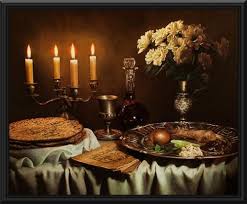
The seder plate consists of ten items which are a reflection of our soul in its most ideal state.  The Arizal uncovers the hidden meaning behind each of the seder plate items. The AriZal advises us to place the seder plate on top of the matzah arrangement (set up from the head of the table). The Seder plate should be set up with the zeroa (shank bone) placed on the top right of the plate (chesed, kindness). On the left of the zeroa we should place the egg (gevurah, strength).We should place the maror (bitter herbs- tiferet, beauty) in the middle of the plate.  We should set the charoset (apple mix-netzach, eternity) on the right of the zeroa and set the karpas (hod-splendor) to the left of the charoset. Under the maror in the center set the chazeret (a sandwich of some of the elements eaten together) and represents yesod-foundation.  The plate itself represents malchut, kingship, which includes within it all of the ten sefirot.  Malchut is the means by which Hashem channels His creative force in this world and reveals Himself in this physical realm.

These elements on the Seder plate also symbolize different middot and emotions.  A Torah observant Jew is called to the holy task of disciplining his emotions.  We are expected to use self-discipline to channel our emotions to ensure that we act out of wisdom and not by impulse.  In order to achieve this lofty aim we must humble ourselves and internalize that our wisdom and the ability to act comes from Hashem.

Specifically, the zeroa is symbolic of an outstretched arm, compassion, a giving nature to love and care for others.  The egg represents discipline which is vital to regulate kindness and love, which must have boundaries in order to be effective. The maror invokes empathy, our ability to feel compassion for another one’s pain and suffering. The charoset reminds us the importance of endurance; to be strong and fortify our emuna. The hard labor, the difficulties that we undergo, should build up our strength and assist us to grow through every challenge. The karpas grows in the lowly earth and teaches us the importance of remaining humble. Finally, the chazeret is the bonding force that brings these middot together, eaten in the sandwich at the seder. In order to experience genuine and lasting emotional and spiritual freedom we must unite with those we love and with Hashem. 

In its entirety the seder plate represents kingship; selflessness. Royalty comes as a result of being related to those of royal heritage- we are a light onto nations, a holy nation. The epitome of healthy self-confidence is knowing where we come from and the G-dly power that lies within us awaiting to be redeemed.


Special Segulot to keep in mind beginning Shabbat HaGadol (Shabbat immediately before Pesach – Apr. 12, 2019), throughout Pesach until the last day of Pesach:

•          Shabbot Hagadol:  the Shabbot before Pesach:  prepare stories on yitzias mitzrayim.  It injects life into the upcoming seder and makes it real for our children.  Try to relate a story each referring to marror, matzah and PesachMarror: anything that talks of our ability to do something above our own means, with great strength. Matzah:  the strength to cope with the circumstances that are handed down to us.  How?  Through connecting to Hashem and drawing strength from our relationship with Him.  Pesach: anything that talks about our geula, our redemption, B’H.

•          Before lighting Shabbos candles on Shabbot Hagadol accept upon yourself a small mitzvah; i.e. netilat yadayim next to the bed, birkat hamazon with kavannah (special intent) from a siddur, etc..  This opens a small pathway where decrees and judgments that might be c’v hovering over can pass over us.

•          During bedikat chametz, it is a time where all of our transgressions are collected and wiped away.  It is just like kol nidrei of Yom Kippur.  Whoever does the bedikah properly, without talking from start to finish and with full sincerity, will be shown the root of his soul’s rectification.  This will come to him in the form of the first thought that enters his mind right after he completes the bedikah and before he extinguishes the candle.  During the bedikah it is an auspicious time to pray. For instance while checking your bedroom: “Hashem, may I be blessed with Shalom bayit, marital peace, love and light in our home”.  While checking your children’s rooms pray that each one will be blessed with….

•          Write down on 10 separate little pieces of paper 10 negative character traits (middot) that you want to get rid yourself of: fear, worries, bitterness, anxiety, anger, stinginess, depression, stubborness, etc. and/or financial debts.  When you burn your chametz throw them into the fire together with the 10 pieces of bread collected from bedikat chametz, the lulav from Succot and, the wicks from Chanukah/Shabbot candles.  The fire cleanses us and cancels out decrees.  You can also throw into the fire anything you would like to cancel; i.e. your apartment rental agreement (so that you can own an apartment and not have to rent!), bad medical test results, debt collector notes or anything else that you would like to have burnt away… Do not throw into the fire names of people you would like to get rid of, ha ha!

•          While preparing the seder plate talk to Hashem and pray to Him:

–           Marror: Hashem may it be Your will that we will be surrounded by sweetness

–           Egg: may it be Your will that we will have wonderful simchas to celebrate

–           Zaroa: save me with Your kind hand from harm

–           Charoset: sweeten the sorrows and sadness

•          While preparing the table, ask for parnassa.

•          There is a segula to say the special tefillah of Rebbi Shimshon M’Astropoli ztk’l on erev Pesach which is found in the Pesach siddur.  Those that say this special prayer will be saved from 10 harsh decrees this year, r”l.

•          During Kiddush at the seder the Chofetz Chaim ztk’l brings down that all of your deceased relatives come to hear Kiddush with you.  Feel their closeness and presence.  This is a special time to ask for your soulmate.

•          First cup of wine represents Sarah Imeinu, second cup represents Rivkah, third cup represents Rachel Imeinu ask for parnassa and fourth cup represents Leah.

•          While eating the celery think about the hatred that still lies within our own nation.  Sinas chinam (baseless hatred) was the main cause that lead our nation into slavery, because of Yoseph’s brothers’ hatred and jealousy.

•          מה נשתנה: during this time ask Hashem for something that has gone unanswered in the past.  Beseech Hashem’s blessing in a way of a story not a request, “Hashem why is this night different from other nights??  I thought that this night I would have be married, I would have…..  I sway from place to place and nothing has changed.”

•          יחץ: ask Hashem to complete that which is missing in your life

•          Say the hagaddah out loud and each word; this repairs the lashon hara that we’ve spoken.

•          רחצה: we ask Hashem that we and our daughters should serve Him with purity and keep all of the laws of purity/ taharat hamishpacha.

•          Matzah: it is the bread of refuah.  We ask Hashem to heal us mentally and physically.  “Hashem please remove any sickness within me.”

•          מרור כורך: we ask Hashem to surround our bitterness with sweetness.  Even though we feel bitterness through trials and tribulations, “Hashem allow me to feel your everlasting kindness and good.”

•          צפון:  we ask, “Hashem please grant me presents that I never imagined I will ever receive…” Specify.

•          ברך: “May it be Your will Hashem that I should always have the zechut to thank you and recognize all of the good that you do for me.  Just as I request from you parnassa, may I merit to thank you in the same way that I ask you to give me.”

•          חצות הלילה, chatzot halayla, usually around 12:41 am on the evening of the seder and also on the last evening of Pesach.  These are very special times, where the gates of heaven are open and many bad decrees can be annulled and prayers can be answered more readily.

Try to sing שיר השירים at this time it is a time of great love and connection to Hashem.   On the last day of Pesach, at this time pray for shidduchim, parnassa, and health from sickness.  They are likened to kriat yam suf (the opening of the Sea of Reeds) this is the exact time when Hashem split the sea.

(Check back during Pesach for more insights into the last days of Pesach and segulot, that will be added to this page)

•          נרצה: we ask from Hashem that we should always be happy and that He should always be happy with us as He is tonight.

•          Before eating the afikoman, the one who hands out the pieces of the afikoman should ask before handing it out to each one at the table,  ‘What would you like’ and then bless them with their request and everyone should answer Amen. This is a Chassidic custom that was practiced by Reb Carlebach ztk’l.

•          When mentioning the plagues and dipping the finger into the wine and dropping it into a separate bowl, think about how you are emptying out all of the plagues from within you and throwing them away.

•          At the seder while we sing our praises to Hashem, He is sitting with us, the gates of heaven are opened and Hashem ‘comes down’ so to speak to be with us.

•          Don’t forget those who aren’t with their families ie; Yonatan Halevi Pollard ben Malkah, Shalom Mordechai Rubashkin ben Rivkah, and others who are still in prison or sick in hospitals and l’havdil the Fogel family that were slaughtered by Arabs, Daniel Arie Viflic z’l ben Tamar and Yitzchok, the Sandler family massacred in Toulose France, the Saeur family who perished in a fire, our brethren that were injured in the past by terrorists (amongst them Odelya Nechama bat Michal, who is still in a coma) and soldiers that were injured in past wars or died, those who are elderly and alone, those that are not in teshuva and don’t celebrate the chag, those who are widowed, those who are single, waiting to get pregnant, etc..

•          During the seder mention a miracle that happened to you in your life, this will ‘encourages’ more miracles to happen in your life.

•          Don’t forget to break off and keep a tiny piece of the afikoman, wrap it up well in foil and then in a bag and place it somewhere in your home where no one will touch it all year long to protect your home and a small piece in your wallet/purse for parnassa.

•          Also don’t forget to keep some matzah from the seder for Pesach sheini, which comes out on יד’ אייר.  There is a special segula to eat matza from the seder on this day.

•          Also keep some matzah in a plastic bag in the freezer to eat on Rosh Hashanah, B’H, this year at the Rosh Hashanah seder.  It annuls harsh decrees c’v hanging over us in the beginning of the year.

May it be your will Hashem that this will be the last Pesach celebrated as a nation separated by darkness, confusion and suffering and that we will truly come together as Your bride and greet You in Yerushalayim in Your palace, b’mheira, b’rachamim, Amen!

imagesCAPG1ZMOpesach_tfilah_3_eng

It’s Never Too Early to Teach Your Children Emuna!

“GIVE YOUR CHILD A BEAUTIFUL PICTURE BOOK THIS PESACH”

leah_book1

Exile and redemption

April 3, 2014
Orit Esther Riter

No Comments

BS’D

The court date for Nissan ben Malka has been postponed until after Pesach. Please continue to daven for him and I will continue to update.  Tizku’ l’mitzvot.

Today’s Daily Dose of Emuna is dedicated to the immediate release of Yonatan Halevi Pollard ben Malka.  May HaKadosh Baruch Hu enable his release without any trade-offs and bring him home safe, sound and in complete health to the welcoming arms of Klal Yisrael, Amen!

Every day we encounter a variety of trials and tribulations; this is likened to living in exile.  So long as we view these challenges from a confined perspective, not relating them to a higher purpose, we live on foreign soil, so to speak.  Exile is defined as being forced to live away from one’s familiar surroundings; seeing life through restricted ‘eyeglasses’ in like living in exile.

Familiarity brings with it easiness of mind, an envelopment of tranquility.  This comes as a result of being in one’s natural environment.  A Jew’s natural habitat is his place of truth – his soul.  We experience a state of exile every time we encounter conflict between that which we know (all that Hashem does is for the best) and that which we feel (‘I am in such pain.  How can this be good?’). Redemption comes when we return to familiar grounds; the place we know to be true and safe – our soul.

The voice of our soul speaks to us the following: ‘Hashem is good and loves you. He is looking out for your ultimate best’; listening to it frees us from our state of exile.  When reminded of the truth we already knew yet forgot, we are comforted.  These words echo emet (truth), a place we have been to before we came down to this world.

Attaching ourselves to Hashem at moments of hardship redeems us from our exile; we leave our Mitzrayim and enter our Eretz Yisrael.  Seeing Hashem in everything frees us of internal conflict and enables us to return to familiar surroundings.  Inside we know it to be true. Emuna is just that – an inner feeling that vibrates Hashem’s truth.

Our redemption lies right there inside of us.  We just need to return to our inner abode called home.

The Daily Dose of Emuna is going on Pesach break for a couple of weeks.  I too must prepare my internal and external surroundings for the upcoming redemption, B’H.

 I wish everyone a Chag Kasher v’Samaech.  May we each be freed from anything that holds us back from living a life filled with meaning, fulfilling our individual missions and shining our true G-dly light.

The Daily Dose of Emuna website is filled with shiurim, articles and past emuna lessons that can help bring us closer to the geula, IY’H.  I also recommend www.G-dDirectTorah.com which offers a beautiful selection of articles and videos relating to Pesach and emuna. 

B’H I hope to work on a special Pesach page on the website www.DailyDoseOfEmuna.com with insights and segulot in the coming days.  I will send an email notifying the readers when it is up and running. 

Looking forward to dancing with you in the women’s section of the Beit HaMikdash b’mheira, b’rachamim ub’simcha, Amen!

Soul language

April 2, 2014
Orit Esther Riter

No Comments

BS’D

Today’s Daily Dose of Emuna is dedicated to the hatzlocha of Nissan ben Malka who is scheduled to have a court hearing today to be released from prison.  I have been B’H dedicating chesed projects in his merit for his safe arrival home and end to his terrible ordeal of being in jail for 3+ years on charges that were not justified.  Please daven for his release.  I will update later B’H with good news, amen.

We live in a generation where we long for practical advice on how to live with Hashem.  Pesach, the holiday of redemption, teaches that through a pure and holy mouth, words that are spoken from our inner point of truth (aka our G-dly soul), is the way.

Prayers that emanate from our soul, words spoken of yearning to connect with Hashem and fulfill His will, are essentially the language of the soul.   They are intimately bonded to our craving to reach our point of greatness and complete the mission which we were sent to fulfill when we came into this lowly world.  Not only does this lead to clarity of mind, thought and action, but it sweetens personal and collective judgments.

Hashem wants only our ultimate best.  Therefore, He will do whatever it takes to shift our paths to where we must travel and for which we are here.  There is a midrash that teaches that Hashem does not want His children to come to Him after 120 and complain with words of, “Why didn’t you ‘wake me up’ and show me that I was living without purpose?”  Hence, Borei Olam does everything possible, keeping with the world’s design of free will, to veer us from our erred path.

The immediate affect of conversing with our Creator and expressing our innermost desire and struggles is one achieved by the known service called therapy.  Actually this is appropriately called ‘self-therapy’, a chance to engage in honest soul searching that in due time rewards us with bountiful emuna.

The month of Nissan

April 1, 2014
Orit Esther Riter

No Comments

BS’D

Today’s Daily Dose of Emuna is dedicated to the personal and collective redemption of Ahm Yisrael.  May this month bring with it blessings of freedom from all difficulties, suffering and hardships; an everlasting release from bondage from all experiences that seemingly appear ‘bad’, and may they be openly revealed to expose Hashem’s loving kindness and compassion for all to witness, Amen!

Today is Rosh Chodesh Nissan, a month that celebrates the Jewish nation’s path to freedom.  When we left Egypt, we ascended to a lofty status.  We were chosen, handpicked, to become Hashem’s people.  In effect, from this point on, we officially were taken under Hashem’s ‘wings’ and guided solely by Borei Olam, no longer subject to natural law.  In Chodesh Nissan, we were elevated to a higher existence – one based on hashgacha pratit (Divine providence). We were no longer subjugated to serve man and were freed to serve our higher selves and the Divine mission- to form an intimate bond with our Creator.

One of the ways we experience freedom particularly this month is through the power of renewal.  Pesach ushers in the spring season and with it flowering buds and greener pastures.  The blossoming surroundings reveal that which was in potential and hidden until now; a pathway likened to redemption. Redemption is revelation – geula (redemption) is rooted in the Hebrew word gi-lui (revelation).  When potential is uncovered and revealed, essentially it is redeemed and freed.

The same is true in regard to our relationship with Hashem.  As we approach Hashem and ‘invite’ Him into our lives, we basically uncover the façade that hides His presence thus revealing His intimate involvement in our lives. Fundamentally, when we chose to see all happenings as being from Hashem and not cause-and-effect or ‘nature’, His guidance becomes crystal clear and undoubtedly will become more known to us in time.

Each one of us can experience a personal redemption by utilizing the freedom Hashem gives to us to see Him in every aspect of our lives.  The geula is in the air.  Just breathe it in and feel free!

I highly suggest signing onto the daily chizuk at Emunadaily@gmail.com.  These are short (4-5 minute) daily audio clips given by Rabbi Ashear. They are filled with stories of Divine providence and easy emuna learning.  Yesterday’s was particularly powerful, here is the link:  https://app.box.com/s/wfjicu53yp9q6vrw8ccr.  Pass it on to others!


Layout mode
Predefined Skins
Custom Colors
Choose your skin color
Patterns Background
Images Background