Category Archives: Daily Dose Of Emuna

Loading
loading..

No Expectations

June 19, 2017
Orit Esther Riter

No Comments

BS’D

Gratitude frees a person from the constant drive for more; it instills a sense of ‘Wow, I have so much’. The soul enjoys the tranquility and basks in the inner satisfaction of having all it needs.

Living in the present encourages us to have gratitude; we are never certain what the next moment brings. Life is an unfolding process that reveals itself piece by piece; therefore who can say what is beneficial or harmful if we aren’t shown the complete picture?  We only have now – and for that we must be thankful.

We should attempt to understand the hidden parts of our lives however often we simply cannot. After the sin of Adam HaRishon everything in life became an admixture of good and bitter; there is good and bitter found in every hardship.  Time and again we generally experience the good in due time after it appeared to be the worst and most trying.

Indeed, acquiring an inner attitude of thankfulness is a challenge; yet the benefits are far reaching. It affects our interaction with others – we become more kind and compassionate, willing to overlook the ‘little things’.  Ordinary acts become reasons to celebrate and express appreciation.

There is a well-known axiom, “No expectations – No disappointments.”  Your washing machine worked yesterday – why think it’ll work today when you turn it on?  Appreciate the little details: ice cold water on a hot summer day, a warm latte’ on a cold morning. Your car started yesterday? Why assume it will today?  Sink into your couch after a long day and be thankful for its embrace. The list goes on…

Being thankful releases us from resentment towards anyone or anything and as a result we are covered in a blanket of peace within and without. Gratitude is the foundation on which meaningful relationships are built; namely the one we have with Hashem, ourselves and others.

Just a Little Light

June 14, 2017
Orit Esther Riter
,
No Comments

BS’D

The core work of the soul is to develop her ratzon (desire to attach to her spiritual source).  The fiery desire of the soul is described as a burning flame lifting herself up and seeking to bond with her eternal root. While doing so she touches other souls and ignites them without detracting from herself.

Indeed the main work of the soul is to shine light onto shadows and penetrate darkness. For that she needs tremendous power; the driving force being her ratzon (her inner desire & longing) to illuminate. Without the existence of darkness light would go unnoticed and unappreciated.

Since she originates from the higher realms she is awarded with the ability to fight her way through all sorts of blackness. Through holding tight to Hashem, the giver of light, no matter what challenges come her way, she is fed boundless light. What keeps her grip tight?  Her ratzon to light up and spread goodness onto others.

The soul is named a candle since this is her essential nature; to fortify her desire each day anew, no matter how difficult it is. The stronger her will the greater the light she is given and stronger her impact on dispelling darkness.

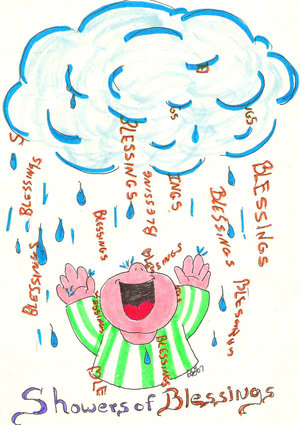
Shower of Blessings

June 13, 2017
Orit Esther Riter
No Comments

BS’D

How do we increase the potency of the blessings we give to others? It is more than muttering words, it is about reaching deep within and mustering up all the care and compassion that dwells inside and sharing it with another. It is a prayer. We pray that the other sees and experiences only good.

Blessing someone is an act of genuine chesed since we are ‘sharing’ our kindness with another.  In addition, we heighten our level of sensitivity to them and thus are able to practice the mitzvah of ‘ve’ahavta l’rei’acha kamocha (loving thy neighbor as we love ourselves)’ in a more heartfelt way.

In order to uplift the blessings that we give let us take a closer look into the Hebrew word for blessing, bracha. Bracha shares the same root letters as the Hebrew word for pool, breicha.  This implies that when we give a blessing we essentially draw from this reservoir of Divine abundance and act as a channel for it to spill forth onto others. Essentially we become the pipeline through which Hashem showers His goodness onto others in this world.

Next time you want to shower Hashem’s love and light remember to bless them with good thoughts and words; you serve as a ray of G-dliness onto others. We carry a spark of holiness that can literally change another person’s life simply by digging deep and accessing that light.

Keep that in mind. Bring down the blessings for others.  We all need them!

The Road to Happiness

June 12, 2017
Orit Esther Riter

No Comments

BS’D

Talking positively makes a profound impact in this world and in the spiritual realm; unfortunately this applies to the effect of negativity as well. Our thoughts may appear to have little effect if any, after all, who knows what I am thinking about. Yet there is spiritual influence that occurs as a result of our thoughts. Uplifting thoughts mobilize positive influence that can actually materialize; the same is true of broken thoughts.

When our minds are filled with emuna it becomes the catalyst for Hashem to shower Divine assistance. Relying on Hashem brings blessing onto our efforts and gives us strength to face challenges.

Cheerful thoughts, speech and actions spreads joy up, down, right, left and all around – to ourselves and everyone around us. Optimism crushes the barriers in this world measure for measure; just as a person faced with difficulty goes beyond her natural tendencies so too may Hashem ‘break down’ the blockages and actualize that which we are hopeful for.

Being b’simcha in essence ‘causes’ the upper realms to follow suit as it brings Hashem endless simcha. The positive outlook and happy disposition we think, speak and act upon has a remarkable impact on high and awakens great fortune worlds away for others; a sign of how we truly are areivim zeh la zeh (responsible for one another).

Intertwine

June 7, 2017
Orit Esther Riter
,
No Comments

BS’D

We search long and hard for the pathway towards Shalom; inner wholesomeness filled with love and acceptance. Yet Shalom implies peace within oneself and among the Jewish people. Within each of us lives inner conflicts as we yearn for inner harmony. The uniting factor is to find Hashem in everything.

In order to love another we must love ourselves. The Ba’al Shem Tov HaKadosh teaches that love of the Jewish people is identical to the love of Hashem. Being that we all carry a part of Hashem we are an extension of G-dliness and should love that part in another unconditionally.

We continuously seek to sustain our soul with love, understanding, acceptance, sympathy and other forms of positive validation. Yet when we run low and those around us cannot provide us with it we should ‘bypass’ (literally do spiritual bypass surgery) and run to Hashem for nourishment.

Love is a gift through which we bind one to another. We were taught the beautiful lesson of love when our soul lived on high. We witnessed how fire and water and other opposing forces lived in peace to sanctify Hashem’s name through complete self-sacrifice.

Jewish souls are intertwined with one another; in each soul there a component of every other soul. Therefore we are commanded to love one another to the fullest extent; the power of brotherly then multiplies and creates a world of love.

Glow of Love

June 6, 2017
Orit Esther Riter
No Comments

BS’D

Every day we recite in our tefillot: “Blessed are You Hashem who chose His nation Israel with love…” and “You love us with an eternal love…” Hashem loves us unconditionally.

The Torah also commands us: “And you shall love Hashem your G-d.” When the Torah makes a commandment pertaining to our actions, we can do our utmost to fulfill them, but how can the Torah command us about our emotions? Love cannot be forced.

The Chassidic masters explain that an immense love of Hashem is embedded in every Jewish heart; we must simply open this channel of love. The mitzvah to love Hashem obligates us to cleanse our hearts and reveal what is hidden under many layers of ego, negativity, and transgressions. We are not forced to love Hashem; but uncover the love that already exists.

Every Jewish heart holds a G-dly spark; a luminous glow of holiness. The yetzer hara tries to destroy it but cannot. He therefore tries a different tactic – to cover it until no one sees or feels their bond to G-dliness buried underneath.

This is the meaning of the verse: “And it will be because you will listen… and I will love you.” The verse is telling us that we will feel Hashem’s love! Although His love for us is always present, it is not always felt. If we will keep the Torah, thereby removing the cover off our hearts, we will actually feel Hashem’s deep love for each and every person.

Carving of the Soul

June 5, 2017
Orit Esther Riter
,
No Comments

BS’D

Emuna originates from the heavenly sphere where the upper lights and creative forces originate. Our soul was carved from this lofty place and directly experienced immense G-dly light. The desire to connect back to this light is the only wish known to the soul; it is the purpose of her existence.

The neshama ‘remembers’ the delight she once knew. However when the soul enters the body her yearning gets mixed up with the body’s lowly desires and gets misplaced and overridden by the body’s needs. It is so easy to forget since the voice of the soul is distant and quiet and the sound of the body is loud and overpowering. Yet it is vital to connect the two and have them work in sync to fulfill their joint mission.

Emuna is that bridge that connects body and soul; it is the knowledge that worldly physical experiences are rooted in Heaven and intended to build the soul. Seeing worldly happenings through the eyes of the soul, through emuna eyes, creates an entirely new reality, a new pair of lenses.

If we were to see the spiritual core in every living thing physical reality would appear as nothingness. The physical world’s existence is maintained by spiritual forces and exists as a result of them. The ultimate reward awaits the soul that bounds herself to Hashem through thought, speech and action by breaking the walls of physicality and illusion and bringing her back to her days of old before she left the Heavenly realms.

Thoughts…

May 29, 2017
Orit Esther Riter

No Comments

BS’D

I would like to take this opportunity to wish the community of the Daily Dose of Emuna and Klal Yisrael an amazing Chag Samaech. We will stand at Har Sinai and receive the Torah as though for the first time. May Hashem stir our hearts and flood our minds with emuna, clarity, simcha and acceptance of all life’s circumstances no matter what we currently face.

My emuna pathway is continuously paved with the teachings of our Chassidic Masters; at the forefront the Holy Ba’al Shem Tov HaKadosh ztk’l. In honor and memory of his upcoming yahrtzeit, the first day of Shavuot together with Dovid HaMelech ztk’l, today’s daily dose brings to light a most profound teaching on the elevation and repair of our thoughts.

From the Baal Shem Tov:

“Someone who engages in Torah and prayer without love and awe will not soar heavenward” (Tikkunei Zohar 10). How much more so if he has “strange” thoughts, which are called kedoshim pesulim (unusable holy things) and are handed over to the outside forces! But when he returns in teshuva, then he raises the holy sparks that have been handed over to the outside forces. So when he stands in prayer or engages in Torah study, then the strange thoughts rise up to confuse his Torah study or prayer, for these strange thoughts are his sins, and they stand before him as in war – but their true intent is that he correct them and bring them out from the depths of their profane coverings.

The Baal Shem Tov taught us extraneous thoughts are a gift. Hashem sends to some of us ‘strange’ thoughts while studying Torah or praying; He trust that they have the power to fix them. These thoughts have been waiting thousands of years to be elevated and corrected. But to the person on the receiving end it seems like a fall; as though he has spiritually drifted away.

This idea is infinitely grand and complex – beyond the scope of what can be taught here. A person is always tested in a way that attempts to break him. One thought takes hold of him, he gets entangled in it, and then it becomes his whole reality – despair. He tries to ‘run away’ and feels he cannot succeed.

Feeling loved

May 24, 2017
Orit Esther Riter

No Comments

BS’D

Emuna, our loyalty, to Hashem is tested when difficulty arises.  When challenges occur we are faced with the questions: ‘Do I believe Hashem loves me now?’ and ‘Can I see the goodness here?’

During a test our power of reasoning decreases and our emotions begin to swell with negativity. Our Chassidic Masters call this katnut d’mochin (a shrinking of our intellect) as our mind takes back seat to the overflow of emotions.  Here we experience tremendous smallness, a loss of control and extremely vulnerable to hurt. The question posted now on a huge banner of lights once again is: “Do you think I (Hashem) love you now?”

The key thing to remember while enduring a test of faithfulness and loyalty (a test of emuna) is that Hashem is lifting us up and empowering our soul to a greater level of G-dliness. Hidden in the word Nisayon is the word Nes which means a flag – an honorary note of distinction which one earns due to facing a nisayon.

An Adam Gadol, a great man (or woman) is in the works while enduring a challenge. Let’s strengthen our emuna by remembering the question and memorizing the answer.

Whats in the way?

May 23, 2017
Orit Esther Riter
No Comments

BS’D

There is a big obstacle that stands in our way of experiencing Hashems great love for us. Through Rashi’s commentary on Parshat Devarim over the incident of the Jewish people claiming Hashems hate for them, we learn an important insight into human behavior.

Human nature is such – what we feel towards another we assume the other feels towards us.  The Jewish people could not feel Hashem’s love in the desert since they were overtaken by their disappointment in Hashem; they felt their needs were not taken care of. An emotion dependent on circumstance is not genuine and will not last. They felt let down and therefore assumed Hashem didn’t care for them.

Our love towards Hashem and to others for that matter should be based on trust and acceptance under all circumstances. Although it may appear there is no logical reason for the sorrow we go through and more so no justification to endure hardship, emuna is most needed at that given moment of doubt. We should remind ourselves and trust that Hashem only has our best interests in mind.

When feeling bitter as though life is unjust, we assume Hashem doesn’t love us; yet that is only what we are feeling towards Him. If we changed the pattern of thought and remembered the countless times Hashem has proven his profound love of us and the Jewish People that would suffice to remove the boulder that stands in between us.

Layout mode
Predefined Skins
Custom Colors
Choose your skin color
Patterns Background
Images Background