
Author Archives: Orit Esther Riter
- Home
- Articles posted by Orit Esther Riter (Page 53)

loading..

What is Emuna?
BS’D
Today’s daily dose of emuna is dedicated to the refuah shleimah of Chayeh Gittel bat Raizel Maryam. May Hashem shower her with a complete healing among all of Klal Yisrael who are sick and suffering b’karov, b’rachamim, Amen.
What is Emuna? To paraphrase Sefer Hachinuch, Mitzva 25- It is the belief that the world has only One G-d and it is through His power and desire that everything ever was, is and will come to exist. Emuna is the foundation of Judaism. Emuna is believing in this fundamental truth as outlined in the Torah and that anything else is simply impossible. This teaching relates to Hashem’s greatness and goodness and our lack of strength and understanding to grasp all matters. From where do we attain our Emuna? R’ Hirsch ztk’l teaches that emuna is the trust that develops from our experience with Hashem’s power and reliability. It is expressed through our willingness to allow our lives to be directed and developed in accordance to His will.
The RamBam ztk’l outlines the thirteen principles of emuna as follows:
1) We must believe that any part of existence is impossible without the existence of our Creator. Yet, the Creator requires nothing for His existence.
2) There is only One G-d. Nothing in the universe can be compared to His Oneness.
3) G-d has no body or physical aspect
4) G-d has always been in existence and always will be. He is eternal.
5) There is no power besides G-d whom it is fitting to serve.
6) G-d bestows prophecy to those who follow all of the Torah commandments and merit to perfect their personal attributes.
7) The prophecy of Moshe was greater than any other prophecy before or since.
8) Belief that the entire Torah is true and completely accurate as dictated to Moshe by G-d.
9) Since the entire Torah comes from G-d, one may not add to it or take away from it.
10) G-d is aware of all of our actions.
11) There is reward and punishment for our actions.
12) Mashiach ben Dovid can come at any time and he will be a greater king than any other human king.
13) At the proper time, there will be a revival of the dead for those righteous individuals who deserve it.
From tomorrow we will further explore each principle.
Pure and Simple Emuna
BS’D
Today’s daily dose of emuna is dedicated to the refuah shleimah of Ayala bat Ruth the beautiful 10 year old girl badly burned this week when a Molotov was thrown at the car she was driving in. May Hashem shower her with a complete healing, refuat hanefesh v’refuat haguf among all of Klal Yisrael who are sick and suffering b’rachamim, b’karov, Amen.
There is a great parable that illustrates the importance of trusting only in Hashem and none other.
There once was a man who became fatally ill. The doctors lost all hope yet the man sent for his Rav to advise him of a cure. The Rav advised that he take seven chickens and boil them for seven days to the point where it condenses the liquid to fit into a spoon.
As he poured the liquid into the spoon and was about to drink, a spider fell into it rendering it unfit to drink. His family was horror-struck and anticipated his death to come shortly after. Yet, he began to recover and in a few weeks was completely healed.
When he was asked how he recovered he said, “When I realized that I couldn’t drink the liquid and that all means of healing were taken from me, I turned to Hashem and cried from the depths of my heart to send me a complete healing. It is the true Healer Who healed me.” When we remove all faith placed with people, cures and solutions to ease our difficulties and in its place rely purely and simply on Hashem Yitborach, we merit His goodness.
Elevated emuna translates into action; our thoughts, speech and actions are profoundly affected by our emuna. Bitachon is the bridge between that which we know and that which we feel and eventually impacts that which we do. When we remove all faith in ‘natural means’ we essentially unclog the pipeline of Divine goodness and enable it to flow freely into our lives.
Join the Next Eight Days of Gratitude from Today!
BS’D
I received this from one of the amazing women on the Daily Dose of Emuna readers list. I think that it comes just in time of Chanukah and I am the first to start tomorrow with my 5 minutes of gratitude, B’H, B’N for the next 8 days of Chanukah.
If we calculate 5 minutes a day times 8 days = 40 minutes of gratitude throughout the days of Chanukah. The number 40 is a very special number as it represents rebirth and renewal. During the next 8 days we physically bring light into the world by lighting our menorahs. B’H we will also enlighten our eyes and warm our hearts to acknowledge the many many miracles that occur daily in our lives; those that we notice and the endless ones that go unnoticed.
We never realize the harsh decrees hovering over and must act to do whatever we possibly can to invoke Rachamei Shamayim (Heavenly compassion).
B’H this will be a life changing ‘exercise’. We all feel we are grateful, yet for the next 8 days we will dedicate 5 conscious minutes each day specifically to verbally express our gratitude to Hashem. Write them to Hashem in a notepad and tell Him, sing to Him or simply cry tears of joy over the gift of life! 5 minutes a day just to say ‘Thank You Hashem!’
Please email me asap so we can account for all the women who will join this most treasured conscious effort to shine forth the essence of every Jew which is Hodaya, Gratitude!
May this serve as a zechut for all of the kedoshim and hasten the Geulah b’rachamim, b’karov, Amen! Pass it on!
The Daily Dose of Emuna is taking a break until after Chanukah, Monday, Dec. 29th. Thank you.
Shalom Orit,
I saw something this morning that inspired me to write you. On my way bringing my son to gan, I saw an arab man driving slowly by the neighborhood shul, videoing the whole front area of the shul. He was driving slowly and videoing as he drove. In addition to calling the police, I feel in my kishkes we need to awaken ourselves and doing something ruchni (spiritual) as a shmira (protection). We are living in such crazy and dangerous times – and I feel I saw this for a reason, and don’t want the moment to pass us by. As we know, Hashem sends us messages, and wants our closeness, and wants our heart.
We are about to step into Chanukah – into the yom tov of miracles. This is the time when the littlest bit of light extinguished all the darkness. This is the time when the few overcame the entire mighty Greek army.
Let’s storm the Heavens! Hashem makes miracles. Chanukah is the time of gratitude, of seeing the blessings, seeing the miracles, and giving thanks. Let’s commit – just for these days of Chanukah – to 5 gratitude minutes a day. Let’s set aside 5 minutes of thanking Hashem for all the good we have in our life. For our family. For our health. For our food. For the blue sky. For waking up this morning. 5 minutes of wearing Chanukah eyes – to see the blessings in our life, and to thank Hashem for all the good.
Can you please pass this along to your readers?
With gratitude and blessings
Do You Smell the Roses?
BS’D
Today’s daily dose of emuna is dedicated to the refuah shleimah of Esther bat Miriam just recently diagnosed with ALS. May Hashem shower her with a complete healing refuat hanefesh v’refuat haguf among all of Klal Yisrael who are sick and suffering b’karov, b’rachamim, Amen.
“Ba’erev Yaleen Bechi, vla’boker rina…. (In the evening one lies down weeping, but with dawn – a cry of ecstasy {delight})”, Tehillim 30:6
Our lives are likened to a roller-coaster ride; up, down and all around. When we are up, in a positive mindset, we are able to accept even the bitter moments with more ease, patience and calmness. You simply accept.
The opposite is true as well. When we feel down we smell the roses but are troubled by the thorns. It puts a damper on our ability to enjoy their fragrance and may even stop us from taking one more ‘whiff’ of their blossoming scent. Therefore, we must always strive to submerge ourselves with optimism. When we think rosy… all is rosy; even if the thorns stand in our way.
When Dovid HaMelech ztk’l describes our evenings filled with tears, he is suggesting the negative times when we are in despair. “But with dawn” points to the times of a positive outlook, the moments when we can see beyond the horizon, see everything in a confident light and this moves us to cry tears of joy.
The lesson to take home: no matter what, we should force ourselves to focus on the roses in every situation and literally fight to stay in a positive thinking mode; with emuna in Hashem, this is doable. The impact of our mindset is more powerful than we can imagine.
It shines light on the saying, “Life is all about perception; not about circumstances.”
You are Royalty!
BS’D
Today’s daily dose of emuna is dedicated to the refuah shleimah of Chaim Avraham ben Bracha. May Hashem shower him with a complete healing refuat hanefesh v’refuat ha’guf among all of Klal Yisrael who are sick and suffering b’karov, b’rachamim, Amen.
Today, the 19th of Kislev, is the yahrtzeit of the Maggid of Mezritch, Rav Dov Ber ben Avraham ztk’l, the disciple of the Holy Baal Shem Tov HaKadosh and the teacher of Rav Shneur Zalman of Liadi ztk’l, the first Chabad Rebbe. The Maggid was known for his humbleness. He helped spread Chassidism to a tremendous extent. May he serve as a holy advocate for Klal Yisrael, Amen. It is suggested to light a candle in his memory, give a few coins of tzadakah and daven in his merit that our prayers be answered for the very best, Amen.
A sense of boundless joy envelops those who live with complete Emuna. Emuna = keen awareness of Hashem’s constant, intimate and personal Presence and intervention in our lives. We must internalize that Hashem is here to see us through the darkness and shower us with clarity, if only we invite Him into our lives.
Every Jew is so precious to Hashem. We hold within us Infinite value by virtue of us carrying a G-dly spark; literally a piece of Hashem. Let us view mitzvot as eternal opportunities to live in the ‘Image of Hashem’. By following Hashem’s Torah instructions we bond with Him continuously; living Heaven on earth.
There is no one like you – no one. Your unique task was created for only you to fulfill and the biggest Rebbetzin cannot fulfill your life’s mission; it was given to you and you alone. What an empowering lesson we learn from this.
Even though your feelings of self-worth fluctuate often, regardless of how you feel, you are a treasure and significantly precious. View yourself from G-dly eyes, not based on what you have been conditioned to believe by various people.
You are royalty. You are the daughter of the King of Kings.
Seeing the Gift
BS’D
Today’s daily dose of emuna is dedicated to the refuah shleimah of Levi Yitzchok ben Raizel, the beautiful 22 year old yeshiva bachur that was horribly stabbed at 770 yesterday. May Hashem send him complete healing b’riut hanefesh and b’riut haguf among all of Klal Yisrael who are sick and suffering b’karov, b’rachamim, Amenb’.
“And you shall love Hashem, your G-d, with all your heart and all your soul and all your resources” (Devarim, 6:15). Masechet Avot teaches there are three levels of love of Hashem: with the heart, soul and resources.
Love must not be reliant upon something or come as a result of receiving something. It must be an intrinsic bond that is unconditional and creates unity; ahavah = one. For most of us love of Hashem begins to emerge out of condition and in time elevates to unconditional love. We recognize where all of life’s gifts originate and how kind HaKadosh Baruch Hu is with us. As a result, our awareness of His presence is sharpened and leads to a deeper understanding that all of these gifts are an expression of Hashem’s love and kindness to us.
Every good idea, every thought, every feeling, our body, our soul, every small detail… our children, our spouse, our family, our money… everything is a gift.
Think about it. Where did all that we have come from? Often we falsely believe that we earned it all with the help of Hashem. But no‼ He gave, gives and will continue to bestow life’s gifts to us. We didn’t help at all!
It’s time to admit how dependent we are on the Borei Olam. Humbleness is not just a virtue, it is connecting to the truth of existence; the only truth. Everything belongs to Hashem, the Melech HaOlam. We are simply a mere guardian of all that we are given and are summoned to use it to serve Hashem and increase our Emuna!
From Weakness to Strength
BS’D
Today’s daily dose of emuna is dedicated to the refuah shleimah of Devorah Nomi bas Raizel. May Hashem shower her with complete healing among all of Klal Yisrael who are sick and suffering b’karov, b’rachamim, Amen.
One of the difficulties of experiencing emotional pain during childhood is that we experience the trauma before the onset of da’at. Da’at is mental and emotional clarity which generally develops with maturity. Thus, the pain sets in before we develop the necessary tools to maturely and rationally process and deal with the hardship.
Children are often not able to absorb and process their pain as easily as mature adults. Most young children (and adults who have not achieved da’at) do not know how to react to such pain and may either repress their feelings or inappropriately lash out. Suppressed feelings may thus emerge at various points in their lives. They may become more aware of the agony inside, but not necessarily where it is coming from or why they are suffering.
Suffering is more unbearable when it feels meaningless or accidental. Viewing suffering in this way may make us feel alone, isolated or unfairly treated. However, when we toil and begin peeling away the layers of emotional pain, we are able to reach our core being and the point of truth connecting us to Borei Olam. This awareness elevates us to a new dimension – a higher consciousness and understanding of the hand of G-d and Divine Providence behind everything that happened to us in the past. The bitterness can slowly change to sweetness. From weakness we are gradually strengthened.
This increased awareness of Hashem’s presence and love represents our coming out of the darkness of exile (galut hada’at). Finally, we realize were never alone or abandoned. HaKadosh Baruch Hu was, is and will always be with us. However, it is only now, after we endure this often slow and painful therapeutic process that we are able to accept this truth intellectually and subsequently feel His Presence in our hearts.
Bittersweet
BS’D
Today’s daily dose of emuna is sponsored and dedicated by Masha Fagel in the merit of her birthday to Klal Yisrael for all of the yeshuot and nechamot, refuah, teshuva, simcha, health, zivug, children, parnassa and Shalom Bayit. What a beautiful way to express appreciation to Hashem for the gift of life.
I just wanted to send you a quick reminder

that my Emuna Workshop series starts TODAY!

CLICK HERE TO REGISTER NOW!
Today, Monday, December 8, my full course about

overcoming challenges, finding our inner strength and

infusing our daily lives with emuna BEGINS!
I'd love nothing more than for you to join me on this journey.
CLICK HERE TO JOIN
By joining you will get exclusive classes that I've never shared before
PLUS
Bonus 1: Building Inner Peace- LIVE MEGA Training($97)
Bonus 2: Personal Email Support  and guidance from Orit (Priceless)
Bonus 3: Emuna Mentoring- Personal phone consultation with Orit ($109)
Bonus 4: An extra seat in the course for a friend or family member ($297)
During the course of our lives, we all traverse paths of darkness (where we feel alone or treated unfairly by others and Hashem, chas v’Shalom. We eventually grow stronger from those experiences. Every descent is followed by an ascent.
Painful experiences are a result of dinim (judgments). When we suffer, a few things may occur simultaneously. Firstly, our da’at (mental and emotional state) may travel further into exile. Our mind and heart may not accept the concept of ‘Gam zu l’tova (this is also for the best)’. We may be thrown into a state in which we cannot see the bigger picture or the purpose of the hardship.
As a result, we may be left feeling lost, confused and distant from Hashem. We may even sense that we are insignificant and unloved which may make us feel despairing. In this unhappy state it is difficult to give or accept love to ourselves, to others and to HaKadosh Baruch Hu.
Chazal brings an amazing insight as to how to sweeten the judgments and lessen our pain. We must go to the root of our pain and view it through our da’at. That is, we must look at the event again and rationally conclude in our minds that it is somehow and in some way for the best. Then, we must gradually allow our emotions (our heart) to digest this rationale.
In other words, we must ultimately view the event through emuna lenses. Higher consciousness helps us deal with the pain since we now associate it with a rational purpose from a more objective and expansive viewpoint. We no longer feel that we are subjects of happen chance. Through this renewed level of understanding, the dinim can slowly change from bitterness to sweetness.
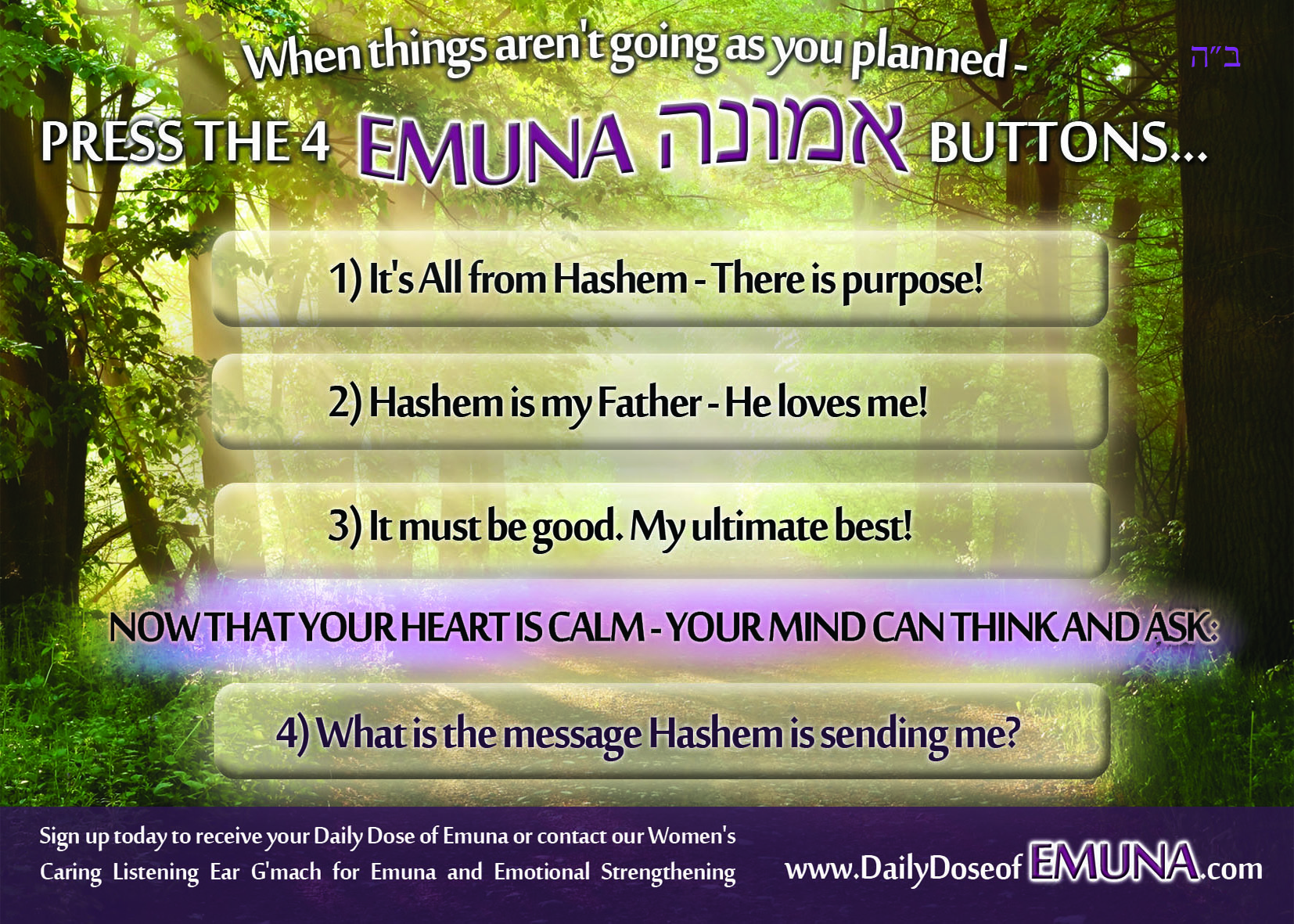
Hashem Will Answer Us!
BS’D
Today’s Daily Dose of Emuna is dedicated to the refuah shleimah of Moshe ben Shoshana Rochel a beautiful six year old in remission. Please Hashem may he continue to heal and live a long healthy life filled with Torah, mitzvot and Ma’asim Tovim among all of Klal Yisrael who are sick and suffering, Amen.
“Ya’ancha Hashem b’yom tzara yesa’gevcha shem Elokei Yaakov (Hashem will answer you in the day of trouble; the Name of the G-d of Yaakov will raise you on high)” (Tehillim 20:2)
“In the day of trouble” – reflects a time of dire need when all the circumstances point to inevitable disaster. Why Yaakov? He was the Patriarch that suffered more than our other Forefathers, according to the Me’am Loez commentary.
Whoever answered him when he was in need, will answer us as well. The recognition, awareness of and trust in Elokei Yaakov will give us the inner strength that we must have to persevere until help will come at last.
Why does the Torah use the name Yaakov as opposed to Yisrael? The Malbim ztk’l teaches that whenever the name Yaakov is mentioned it refers to the common folk. It also applies to the physical aspect of Yaakov’s personality. Yet when the name Yisrael is used it refers to the Torah scholars and righteous among the Jewish people. Essentially Yisrael represents the spiritual aspect; the eternal existence of the Jewish nation.
This fascinating insight into this passuk in Tehillim comes to highlight that Hashem is embracing every Jew at their time of need. He is with each of us, guiding and caring the ‘average’ person, who stumbles and attempts to improve time and time again. Hashem intimately supervises us in this lowly world no matter how low we might have fallen.
Stay Connected


Categories
- 40 Days Of Gratitude (30)
- Aish.com Articles (4)
- Breslev.co.il (3)
- Challah Baking (3)
- Chanukah (4)
- Daily Dose Of Emuna (747)
- Delectable Emuna (10)
- Elul (23)
- Emuna Energy Therapy (1)
- other (6)
- Our Trips (2)
- Pesach (6)
- Purim (3)
- Rosh Hashanah Segulot (1)
- Segulot (4)
- Segulot Chanukah (1)
- Segulot for Yom Kippur (1)
- Segulot Shavuot (1)
- Shavuot (7)
- The Ratzon Chabura Workshop (1)
- Tish BeAv (3)
- Tu BiShvat (1)
- המנה היומית של אמונה (14)
Tags
anger
Av
bitachon
chanukah
daily dose of emuna
Divine Providence
Elul
Emotions
emuna
fear
Galut
geula
gratitude
happiness
hardships
Hishtadlut
hitbodedut
joy
marriage
neshama
Orit Esther Riter
Parnassa
passover
Pesach
purim
Purim segulot
Purim segulot and insights
Rosh Hashanah
self-improvement
self-worth
Shabbat
shavuot
Shechinah
soul
Story Time
Succot
suffering
Tammuz
tefillah
tehillim
teshuva
Thirteen principles of Emuna
Tu B'shvat
war
Yom Kippur
This month’s daily doses
| S | M | T | W | T | F | S |
|---|---|---|---|---|---|---|
| 1 | 2 | 3 | 4 | 5 | 6 | 7 |
| 8 | 9 | 10 | 11 | 12 | 13 | 14 |
| 15 | 16 | 17 | 18 | 19 | 20 | 21 |
| 22 | 23 | 24 | 25 | 26 | 27 | 28 |
| 29 | 30 | 31 | ||||
Layout mode
Predefined Skins
Custom Colors
Choose your skin color
Patterns Background
Images Background