Yearly Archives: 2016

Loading
loading..

Personal Prayer in Practice ~ Part II

May 17, 2016
Orit Esther Riter
,
No Comments

BS’D

One remarkable effect of hitbodedut is the ability to deeply connect to Hashem in a close and personal way. This process illuminates our soul. Through emotional discourse – words of praise, appreciation, desire, will, lament, and honest reflection – we are able to bond with our Creator on the deepest level.

Our souls’ true desires are often covered over by the desires of our guf, body. Hitbodedut enables us to shed the layers of the guf and some of the genuine desires of the soul begin to surface. For instance, we may begin to feel and access our desire to be righteous and not transgress, to be happy, to live with zest and strength, to increase our emuna, see good in all things and in everyone, a strengthening of self-worth and honor. Above all, this process enables us to truly feel Hashem’s constant and intimate presence.

One highly beneficial part of hitbodedut is to utter words of gratitude. This demonstrates our contentment and our firm emuna that Hashem does everything for the best and that He listens to our tefillot. Expressing appreciation also motivates us to continue to pray with anticipation that the ultimate good will be revealed. We all have friends, relatives and others who support and assist us; B’H we are not alone in this world. Thanking Hashem for our loved ones keeps our blessings coming.

If we are stuck for something to thank Hashem for, Chazal suggest that we visit a hospital or a cemetery. By comparing ourselves to others in the community who are less fortunate than us, we automatically feel appreciation for what Hashem has blessed us. This process of contrasting ourselves with others may minimize the need for Hashem to send us intense challenges in order to encourage us to appreciate the beauty of an ordinary day.
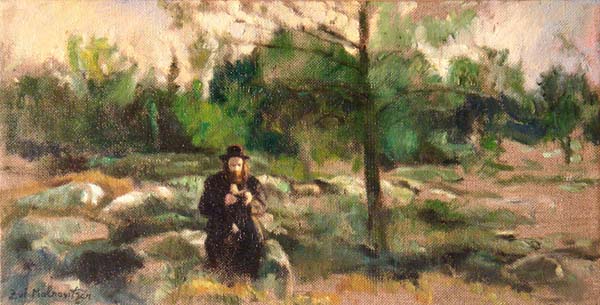

Personal Prayer in Practice

May 16, 2016
Orit Esther Riter
,
No Comments


BS’D

The process of pouring our heartfelt thoughts and feelings to Hashem often enables us to feel cherished and uplifted. Rebbe Nachman explains that hitbodedut is meant to be a deep, intimate talk with Hashem in order to reach heart-felt issues that need to be addressed. Chiseling through the fortress surrounding our hearts requires a significant period of regular time to open up and acknowledge our feelings and emotions. He therefore advises us to do one hour of hitbodedut a day in order to reach this deep, penimi place, this deep place within.

In terms of location, Rebbe Nachman suggests that the most effective hitbodedut is achieved in a private space or in the fields. The fields offer open space and views of nature , which may enhance our connection with Hashem. Though we should also bring Hashem into our everyday lives and speak with Him during all activities, whether driving, folding the laundry and/or washing the dishes, this is not Rebbe Nachman’s hitbodedut per se’. Rather, Rebbe Nachman is referring to talking to Hashem, ‘face to face’ while not engaging in any other activity other than perhaps taking a drink which doesn’t disturb our mode of focus.

Ideally we should set aside a private spiritual ‘corner’ in which we regularly pray, learn and do hitbodedut. We may associate this holy setting with spirituality and this association may enhance our spiritual connections. However, such a separate space is not crucial and we can carry out hitbodedut even while traveling as a passenger and pretending to read a book or while walking in public, while sitting in a public space or in bed under the covers (being careful not to fall asleep!).

Regardless of where we carry out the process, the main thing is to be alone, without being disturbed. The crucial element of this practice is to open ourselves up honestly and connect with Hashem’s presence.

Today’s daily dose of emuna is dedicated to the refuah of Binyamin Yitzchak Yosef Leib ben Faiga, a young father who is in serious condition in need of a lung transplant. May Hashem shower him with a complete healing among all of Klal Yisrael who are sick and suffering, b’karov, b’rachamim, Amen.


Personal Prayer ~ Part III

May 11, 2016
Orit Esther Riter
,
No Comments

BS’D

The Higher Heavenly court asks each of us an interesting question: “Did you appoint regular times for learning Torah?” One lesson we can extract from this question is the importance of regular, consistent practice as opposed to sporadic, albeit heartfelt prayers. Although it is a beneficial and admirable to ‘run’ to Hashem and talk over our deepest emotions and concerns the long-term benefits of hitbodedut is achieved best via everyday ‘ordinary’ talk.

Every hitbodedut session is a personal encounter with our Creator. Practiced on a regular basis, hitbodedut forges a deep connection with Hashem that cannot be severed easily. It is called “a lofty level greater than all” Rebbe Nachman ztk’l teaches. Consistency, routine and repetition work best, even at times when it appears there is nothing special to discuss.

Many question Rebbe Nachman’s teaching of the importance of one hour of hitbodedut. Some are concerned about the unrealistic nature of setting aside a whole hour dedicated to Hashem every day. In actual fact, Rebbe Nachman writes, “… one hour or more…”! He teaches that we should ideally strive towards transforming our entire lives to one dynamic intimate conversation with Hashem.

Let’s begin with setting aside a consistent block of time to open our hearts and mouths to our Creator. Let’s choose an authentic length of time, no matter how short a time period, at the most convenient time of day Then, gradually, we can build up towards our “one hour per day” goal. And in order to succeed, we can pray to Hashem to help us set aside this time to achieve our goal.

Today is memorial day in Israel. It is special to take a moment to pray for the souls who have departed from this world and their families.  May Klal Yisrael merit the geula without pain and tragedy, Amen.

Today’s daily dose of emuna is dedicated to the refuah shleimah of Ahava Emuna bat Chava Etta, a young bother battling stage 4 cancer with tremendous pain and difficulty.  May Hashem shower her family with strength and heal her, b’riut hanefesh v’b’riut haguf among all of Klal Yisrael who are sick and suffering b’karov, b’rachamim, Amen.


flyer revised

Personal Prayer ~ Part II

May 10, 2016
Orit Esther Riter
,
No Comments

BS’D

The period between Pesach and Shavuot serves as a bridge between our freedom and the purpose of that freedom. It is a time to prepare spiritually for the revelation to come, our receiving the Torah.
Arguably, one of the most powerful ways of freeing oneself from constraints is the practice of hitbodedut.

Hitbodedut is simply defined as personal secluded one-on-one prayer between us and our Creator. According to psychological principles, the best road to a great relationship is communication. Hitbodedut is essentially communication, but a special form of communication used to forge a relationship with our Creator. Hitbodedut is an opportunity to talk over with Hashem our feelings of appreciation, our regrets, goals and our wishes.

However, speaking to Hashem is more challenging that one might think! Rebbe Nachman ztk’l teaches that due to the power and significance of hitbodedut we will face many obstacles to overcome in order to find the time to speak to Hashem in this way. The evil inclination understands the power of establishing a close-knit relationship with Hashem through hitbodedut. It will probably challenge us each time we attempt to seclude ourselves and open up our hearts. For instance, the yetzer hara may argue: “What do you need to talk about anyway? Don’t you feel awkward talking to the ‘air’?” Or he may just keep us so busy we do not feel we have the time to spare to undertake such a practice.

Yet, we can overcome these obstacles! We can fire up our ratzon (willpower) by reminding ourselves of the significance and effectiveness of hitbodedut. And when we show Hashem we are willing to do this avodah anyway, we will find that talking to Hashem in this way is uplifting. It reinforces through our actions and speech what our neshama, our soul always knows is true – that Hashem indeed is everywhere and with us always.

Hashem deliberately creates a lacking or absence in our lives to encourage us to turn to Him and connect with Him via processes such as hitbodedut. He creates this lack or need out of His kindness and mercy, knowing that the maximum pleasure we can obtain in this world is by connecting with Him. However, if we choose to connect with Him on a regular basis and not merely when we are lacking, He will not need to send us deprivation in order to impel us in His direction.

Today’s daily dose of emuna is dedicated to the refuah shleimah of Eliyahu Moshe ben Devora and Chana bat Devora. Two children of one family: 28 year old fell from electric bicycle and has bleed in brain. His younger sister was involved in car accident a week after with painful back injuries. B’H may we hear good news soon for Klal Yisrael and no more pain and sorrow, Amen.

flyer revised

Personal Prayer ~ Part I

May 9, 2016
Orit Esther Riter
,
No Comments

BS’D

Prayer is a Jew’s greatest weapon. Rebbe Nachman ztk’l teaches that each Tefilla is likened to ‘an organ of the Shechinah HaKedosha’ which helps build this world, transforming destruction into perfection’ There is a Midrash that teaches that Mashiach will take all of Klal Yisrael’s soulful prayers and arrange a weapon of mass destruction to fight our enemies forever.

However, prosecutors stand ready to snatch our Tefillot, blocking them from ascending to the Heavenly realms. These prosecutors often arise due to our own transgressions. In order to overcome such blocks, we need to create new pathways. Rebbe Nachman teaches us an overlooked method of overcoming such impediments to our Tefillot called hitbodedut. This method of prayer was used by our Imahot and Avot. We can view hitbodedut as a form of ammunition that wards off negativity from our lives.

But a question arises – how does hitbodedut differ in any significant way from our prescribed Tefillot of the siddur? The heavenly prosecutors blocking the ascension of our prayers know the spiritual channels through which our prescribed Tefillot rise.

In contrast, each time we do hitbodedut we create a different channel unknown to the prosecutors. Unlike prescribed prayers with which the prosecutors are familiar, prayer via hitbodedut is fresh at each moment it is uttered. It represents a heartfelt, soulful yearning full of deep ratzon that is pure and unique to each individual person. The prosecutors have no template for such an inimitable form of prayer and are taken by surprise.

Each time we pour our hearts to Hashem – through words of gratitude, teshuva or requests – we ignite our soul and we heal our souls. As we enter our hitbodedut a remarkable process begins to occur – our inner soul’s craving and desire to fulfil our true life’s mission surfaces and the darkness, confusion and gloom consequently fades. It enables us to access that deep, soulful place inside of us that knows what is truly right and best for us, and thus to align our ratzon; our will with His Will.

Today’s daily dose of emuna is dedicated to the refuah shleimah of Lynn Marilyn Tsivia bat Sara. May Hashem shower her with a complete healing b’riut hanefesh v’b’riut haguf among all of Klal Yisrael who are sick and suffering b’karov, b’rachamim, Amen.
flyer revised

Feeling Like a Slave?

April 13, 2016
Orit Esther Riter

No Comments

BS’D

Living in Mitzrayim is likened to living in a mute world with no voice, no opinion and no ability to express one’s identity. Essentially the Jewish people were under complete subjugation to the whim and will of the Egyptians. Emotionally this means totally alienation, loss of self-worth; a crumbling of the heart. The Jewish nation had succumbed to the fact that, ‘This is the way it will be and there is nothing we can do about it.’ In effect, the Egyptians choked the Jewish people to the point where they could no longer cry out for help.

Redemption is a state-of-mind. Seeing Hashem no matter how difficult life is removes us from that ‘narrow place’ called Mitzrayim and injects us with emuna that our voice matters. Emuna infuses us with strength and determination to exit out of those tight corners in life. We trust in Hashem that just as He redeemed us from Mitzrayim and was with us in our darkest hours, so too today.

The formation of the Ahm Yisrael began through the experience of Yitziat Mitzrayim; “Ani v’lo Saraf (It was I and not an angel (who redeemed you)”. Our cleaning wipes away the myth that it is anything else but Hashem! Hashem was personally involved in my redemption! As we clean we are to check, seek and search the areas in our lives that are covered in dust and shmutz and hide Hashem.

The most effective cleaning tool is not Sano or Mr. Clean… its tefillah. As we talk to Hashem we free our emotions and open our hearts to feeling Hashem’s presence. We proclaim that Hashem is ‘behind, around and within’ everything, even if we don’t clearly see it. Particularly through the act of talking to Hashem while preparing for Pesach we experience redemption, we let our voices be heard and we build our Jewish identity.

Let’s remember that next time our hands and feet begin to ache. Have a wonderful Chag Kasher v’Samaech.

Today’s daily dose of emuna is dedicated L’iluy nishmat my dear emuna soul-sister Chaya bat Baya a’h.  The latest “Chaya: A 40-Day Modesty Campaign” was then dedicated to Chaya’s refuah.  After a long and difficult 8-year battle with cancer, Chaya is now resting in Hashem’s arms.  She was a beautiful soul who taught me what it means to live with heartfelt unwavering emuna.  May her soul bask in the Divine radiance among all of the righteous who have departed from this world, Amen.

The Daily Dose of Emuna will return Rosh Chodesh Iyar IY’H or sooner with the geula shleimah and building of the Beit HaMikdash b’mheira, b’rachamim, Amen!

Palmolive Hands?

April 12, 2016
Orit Esther Riter

No Comments

BS’D

We are up to our elbows in bubbly soap… for this we should be happy?  Without preparation there can be no joy!  Let us focus our attention on what we are striving to clean and create.

What a great privilege to have been chosen to be G-d’s people and to have been granted the opportunity to stand in the company of angels.  With every scrub, brush and wipe we draw down Holy light into this world, our soul and into the souls of our families.  Imagine for a moment that you are preparing for a festive meal in Gan Eden; the Shechinah HaKedosha and Her majestic Heavenly Hosts are crowded around to hear the prayers recited at your Pesach seder table.

Every Jew can feel Hashem’s presence on Seder night and experience Heavenly delight.  What sweetness! Hashem saved each of us personally from the onset of the plagues; we were spared because Hashem made us a part of Himself, so to speak.  A special relationship began to develop since Hashem took us out of Mitzrayim; a unique feature of this bond remains alive in Yisrael until today.  We are a nation apart, divinely protected, distinct from the rest of the world.

Therefore the main aspect of preparing for Chag Pesach is to be b’Simcha; to praise Hashem for all the hidden and revealed goodness and miracles in our lives. We glorify Hashem and express our profound appreciation for this once-a-year-mitzvah in which we work to remove falsity on the inside through cleaning actions we perform on the outside.

Today’s daily dose of emuna is dedicated to the refuah shleimah of Yeremiah Yosef ben Shoshana, a 4 year old boy with retinoblastoma who recently had his remaining eye removed and is now being evaluated for a spread of the cancer to another area. His parents are asking others to daven for his complete recovery. They give permission for others to share his name on tehillim/davening lists. In the merit of the month of Nissan, the month of yeshuot and great miracles, may Hashem Yitborach shower Yeremiah Yosef ben Shoshana with a complete healing among all of Klal Yisrael who are sick and in pain b’karov, b’rachamim, Amen.

Free… Who’s Free?

April 11, 2016
Orit Esther Riter

No Comments

BS’D

Freedom from Mitzrayim refers to psychological freedom. In today’s world many are still enslaved; not physically in shackles and chains but mentally imprisoned. Often people find themselves bonded to certain beliefs and values unable to feel free to realize their greatest potential. Freedom is essentially the ability to live out one’s mission and potential clear of oppressive and dominating outside forces. Mental confusion and emotional instability are two major obstacles that keep us in our own ‘Mitzrayim’. Time and again we become confused why we are here causing frustration and negativity.

To this end we are instructed to remember our exodus from Egypt; since we are constantly in the process of ‘leaving’ Mitzrayim. The universal message embedded in Chag Pesach is that we are always leaving Egypt; fighting off oppressive external forces and seeking inner freedom. The Jewish people must live life knowing that they are not to be afraid or disturbed by life’s challenges and events; deep within they are to remember that Hashem is helping to free them from their emotional instability but reminding them that He is personally involved in their lives.

You may ask, ‘What does freedom feel like?’ Freedom is a sense of empowerment; living with the mindset that the Master of Creation has set no limits on who you can be and how much G-dliness you can achieve. Through witnessing the wondrous miracles of the exodus we were given emuna; a clear awareness that existence is filled with G-dliness and purpose. Our lives are continuously infused with Divine assistance that assists us every step of the way. That is true freedom.

Today’s Daily Dose of Emuna is sponsored L’iluy nishmat Olga Irene bat Shmuel Itzik, Mother to Meira Michal, Grandmother to Baruch Chaim, Yoel Yehuda and Gabrielle.  May her neshama bask in the Divine Radiance among all of the righteous who have departed from this world, Amen.

Day 40 ~ Global Gratitude Revolution

April 8, 2016
Daily Dose Of Emuna
No Comments

BS”D

DAY 40!! Let this be a launch!

Wow! Wow! Wow!

We’ve arrived at day 40 of our 40 Days of Gratitude journey! Kol Hakavod (loosely translated as, “way to go”) to everyone!

I am grateful for each one of you that is reading this, working to cultivate gratitude in your own personal world, and contributing to the collective energy of gratitude in the world around us. In Jewish wisdom, a human being is called a little world. What we do creates ripples in the cosmos. Our actions, our words, and even our thoughts make an impact on the world around us – practically, energetically, and spiritually.

I am grateful for this journey we’ve embarked on together.

And this is only the beginning.

In Judaism, 40 is the number that signifies birth and renewal. Just as there are 40 weeks in a pregnancy, and 40 years of wandering in the desert before entering Eretz Yisrael – 40 is an end of something which gives birth to something new.

So let this be a launching pad for each one of us. Let’s continue flexing and building our gratitude muscles – even after these 40 days.

Make for yourself a “gratitude chevrusa” (aka a gratitude buddy/learning partner). This could be a friend you can call for 2 minutes a day to share with one another something you are each grateful for – or for those days you are struggling for gratitude – someone who can help give you back your gratitude glasses.

Use the ideas here that resonated with you. Practice gratitude – find things to be grateful for. Do it in your thinking. Talk about it with a friend. Make it part of your family culture. Start a gratitude journal or a gratitude jar. Get into the practice of sharing little miracle stories with your family over the dinner table or with your best friend when you meet for coffee. Take 2 minutes at the beginning or the end of your day to actively think of the little and big blessings in your life for which you are grateful.

Let us each continue to cultivate gratitude in our own lives. Let’s create a gratitude revolution by changing the way our eyes choose to see – by continuing to refocus our eyes to see the world with miracle eyes. Let us try to tune in to see the miracles blossoming for us, and around us, all the time. And let us each work to inspire ourselves in a way that also creates a ripple and inspires others around us.

Stay in touch! Let us know how it is going. We would love your feedback about this initiative – how it was for you, what was helpful, what you would have changed. And keep your eyes open for our next 40 Days of Gratitude campaign.

Email us at: Orit Riter: oritriter@gmail.com

Individually and collectively we can make a revolution!

PS. Someone recently commented that they assumed gratitude came easy to me – given all these ideas I am sharing and writing and trying to incorporate into my life. Just as an FYI, I work on this and struggle with this. I have hard days and cranky moments. Which is why, even more so, this is something I am working on. At the times when I feel expanded consciousness and it’s easy to see the blessings – fantastic. And at those times I am stuck in constricted consciousness, then I fight for the gratitude. Sometimes I succeed, sometimes I don’t. But just remember – especially at those harder times – it’s the effort that matters much more than the outcome!

For no particular reason say ‘Thank you Aba, I love You and thank you for giving me life!’

Layout mode
Predefined Skins
Custom Colors
Choose your skin color
Patterns Background
Images Background