Monthly Archives: November 2016

Loading
loading..

Hashem’s Way is the Best Way

November 8, 2016
Orit Esther Riter

No Comments

BS’D

Difficulties can best be dealt with through self-restraint. When we internalize the idea that it isn’t a stroke of bad luck we will have the courage to believe and face the challenge with success.

Coincidence is a concept that frightens us; weakening our ability to make it through the dilemma.
In spite of the fact that we can’t always figure out the purpose behind certain events, it does not mean there isn’t a Divine logical reason and purpose. My famous saying, “G-d has a plan, I just don’t know what it is!” Emuna is remaining loyal to the teaching that Hashem has a fantastic reason why He planned our life just so. Hashem’s way is the best way.

Indeed we do not have the spiritual eyes through which clarity is absorbed. Yet holding onto Hashem through difficult times means we don’t interpret difficulties as a ‘stroke of bad luck’; but as a growing tool that serves our ultimate benefit eternally. After 120 the ‘big picture’ will be clearly displayed before us because our limited corporal vision will be a thing of the past.

Finite existence is one of the main obstacles of emuna living. We are self-contained, living in a bubble of time and space and only see within the context of our finite and relative bubble. Therefore the greatest impression we need to sear into our minds and hearts is that there is a greater reality. Eventually when our bubbles burst we will see what was outside of us all along.

The King’s Boulder

November 7, 2016
Orit Esther Riter
No Comments

BS’D

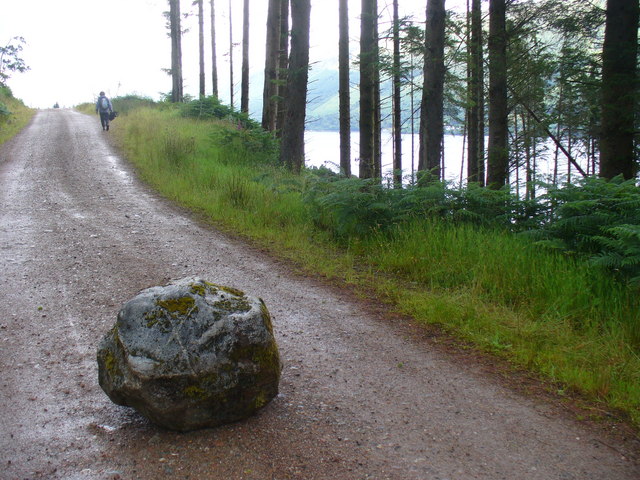
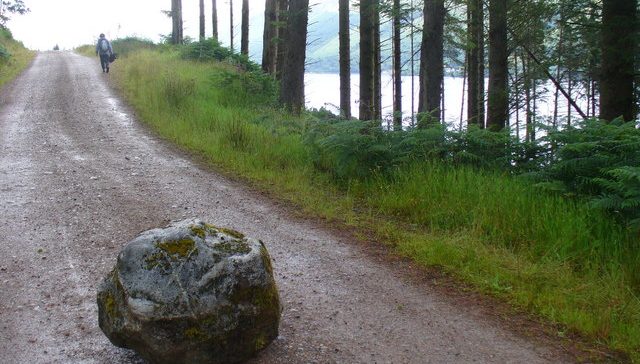
There is a tale of a king who purposely places a boulder in the middle of the road. He then hides himself and waits to see what would happen. He notices that many people walked around the boulder and overheard many of them loudly blaming him, the king, for not keeping the roads clear.

Eventually, a peasant carrying a load of vegetables spies the boulder. He lays down his heavy load. After straining and pushing he finally succeeds in moving the boulder to the side of the road. As he turns away to collect his box, he notices a pouch in the middle of the road where the boulder had previously stood. He opens it up and to his delight, finds many gold coins hiding within.

The pouch also contains a hand-written note signed by the king. The note explains that the king himself had purposely placed both the boulder and the gold coins in the middle of the road. Only the person who removes the load is to be rewarded with the bounty.

This peasant learned a powerful lesson that many of us fail to understand. Every obstacle presents an opportunity to improve our condition. Life is full of challenges. We have a choice in our attitude and our response to these challenges. We can view them as annoying hindrances and circumvent them, complaining all the while and blaming the King who sent them. Or we can develop a healthy attitude on how to address them.

If we fail to address our problems, eventually they will destroy our lives. Our task is to grow and mature through our challenges, using them to help us build character, make us strong and connect to Hashem.

Hashem Speaks

November 2, 2016
Orit Esther Riter

No Comments

BS’D

Hashem communicates to us through the circumstances of our lives. Our individual life circumstances reveal our tikkun – those difficult and repetitive challenges which we must embrace and then learn to complete. Through our daily challenges, Hashem instructs us as to how to grow wiser, stronger and assume responsibility for our choices.

We can choose to view our repeated and disproportionate emotional responses as indicators of the precise areas in our lives that we need to improve.

Our emotional buttons being pressed are really our souls calling out for us to work on this area of our lives. Hashem is presenting us with unique opportunities that enable us to reach parts of our nefesh that otherwise would have gone unnoticed.

In order to complete our tikkun and undertake the mitzvot properly, we require self-awareness. For instance, we must learn what annoys us and why, what triggers our defenses, and what are our true motives.

The following five practical ways may help us increase self-awareness and shed any pretense:

  • Get to know yourself by zooming into your true life’s purpose, strengths and weaknesses. Our weaknesses need to be identified and embraced before they can be worked on.
  • Make a commitment to face the truth despite discomfort and avoid the temptation of excuses (used in order to avoid short-term pain)
  • Contemplate and reflect on behavioral patterns and emotional responses
  • Be patient with yourself and the process
  • Be open and willing to accept your weaknesses, to be understanding of yourself and therefore of others

Difficult and painful events offer the chance for us to grow emotionally into new people. We each have the potential to have an ‘old’ me and a ‘new’ me – that is, to create a new person by growing through an experience.  Each experience provides us with the opportunity to create new thoughts, speech and actions (and/or reactions), and consequently to reveal another aspect of our soul.

Though this process is not easy, we must have emuna to know that eventually we will be successful at growing to the point where we feel at peace with ourselves on the inside. This internal shift will B”H enable us to also live a genuine Torah life on the outside.


A Narrow Bridge

November 1, 2016
Orit Esther Riter

No Comments

BS’D

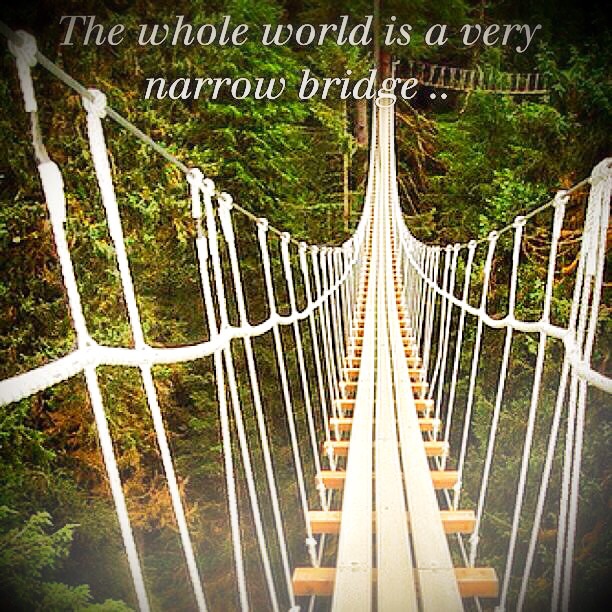
Rebbe Nachman ztk’l teaches, “Kol ha’olam kulo gesher tsar m’od v’haikar lo l’fached klal – that the whole world is a narrow bridge, but the essence is not to be afraid”.

Whether or not we realize it, we are all traveling along a narrow bridge. Where are we heading?  The constricted pathway leads one to find the ‘real me’.  The task of the Jewish people is to discover our G-dliness and reveal our potential – an awesome task indeed!

But Rebbe Nachman teaches that we must continue along the bridge of life despite its narrowness. We should not let fear stop us crossing. This narrow bridge is confined, slender and even cramped, yet it is the road to happiness and must be crossed.

Fear is an emotion that can lead to a number of negative consequences, including:

  • Defensiveness
  • Resistance
  • Anger and blame

What do we fear? Fear may take many forms, including such things as fear of:

  • failure
  • hardships and difficulties and pain, and
  • a lack of assistance.

Why do we fear?

In its essence, fear in anything is a lack of trust and fear in Hashem.

What can we do to overcome fear?

Fear can be overcome through trust in Hashem.

The Rebbe advises us while we are crossing the narrow bridge we should not to look down (symbolizes one’s shortcomings). Rather, we should look up and increase our Yirat Shamayim. As our emuna in Hashem increases, our fears naturally subside.

Ultimately, when we shed our fear, we can more easily achieve our lifetime journey of crossing over our narrowness, insecurities and downfalls in order to reach our G-dly side and bring it out into the world.


Layout mode
Predefined Skins
Custom Colors
Choose your skin color
Patterns Background
Images Background